Ecological Discourses and Practices in New Right Periodicals - Stefan Rindlisbacher
When the New Right emerged in the 1960s, it grounded its ecological concerns in older discourses and practices drawn from the youth and life-reform movements as well as from völkisch circles of the early twentieth century, including dietary reform, naturopathy, and rural communal living. While these practices were largely retained, their far-right interpretive frameworks – including biologism, eugenics, Social Darwinism, and a agrarian ideology – were reshaped to align with the social conditions of a liberal-democratic society. A key example of this process was the transformation of the racist “blood and soil” ideology into an ethnopluralist bioregionalism, which claimed to promote cultural diversity while continuing to pursue the ideal of a homogeneous Volksgemeinschaft rooted in specific natural landscapes. At the same time, New Right currents such as the National Revolutionary movement deliberately sought connections with thinkers from the 1968 movement, Marxist cadre organizations, and the left-alternative milieus of the 1970s. They not only adopted innovative forms of protest and collective organization, but also appropriated linguistic styles and visual aesthetics developed within these milieus.
The periodicals produced by New Right groups in the orbit of the National Revolutionary movement – such as Sache des Volkes (SdV) and the Solidaristische Volksbewegung (SVB) – are particularly valuable sources for tracing these continuities, shifts, and reorientations of the far right over several decades. Central attention is paid to publishers and intellectual figures such as Henning Eichberg, Lothar Penz, and Siegfried Bublies, who played a key role in shaping discourses on nature, the environment, and health and appropriating design elements from the New Left. Their work reveals how far-right ideologies – nationalism, racism, and antisemitism – were combined with anti-colonial, anti-imperialist, regionalist, and ecological demands, thereby laying the foundations for a “New Right” that presented itself as modern, progressive, and alternative.
The project therefore focuses on National Revolutionary periodicals such as Neue Zeit (1975–1986), Rebell (1971–1980), Sol (1974–1979), and Wir selbst (1979–1992). Although these publications have received little attention in academic research, they are widely referenced today in new-right intellectual circles. Therefore, examining these sources can help us to understand how the far right has been able to regain such a strong influence in the 21st century. Discourses on nature, the environment and health are particularly revealing because they demonstrate the attempts of the far right to influence public debates, adopt protest movements and reinterpret everyday practices. These strategies have been further developed in the social media era, but were already evident in the counter- and alternative media of the 1960s to 1980s.
Source example:
Sol – Organ der solidarischen Volksbewegung (SVB), 1975.
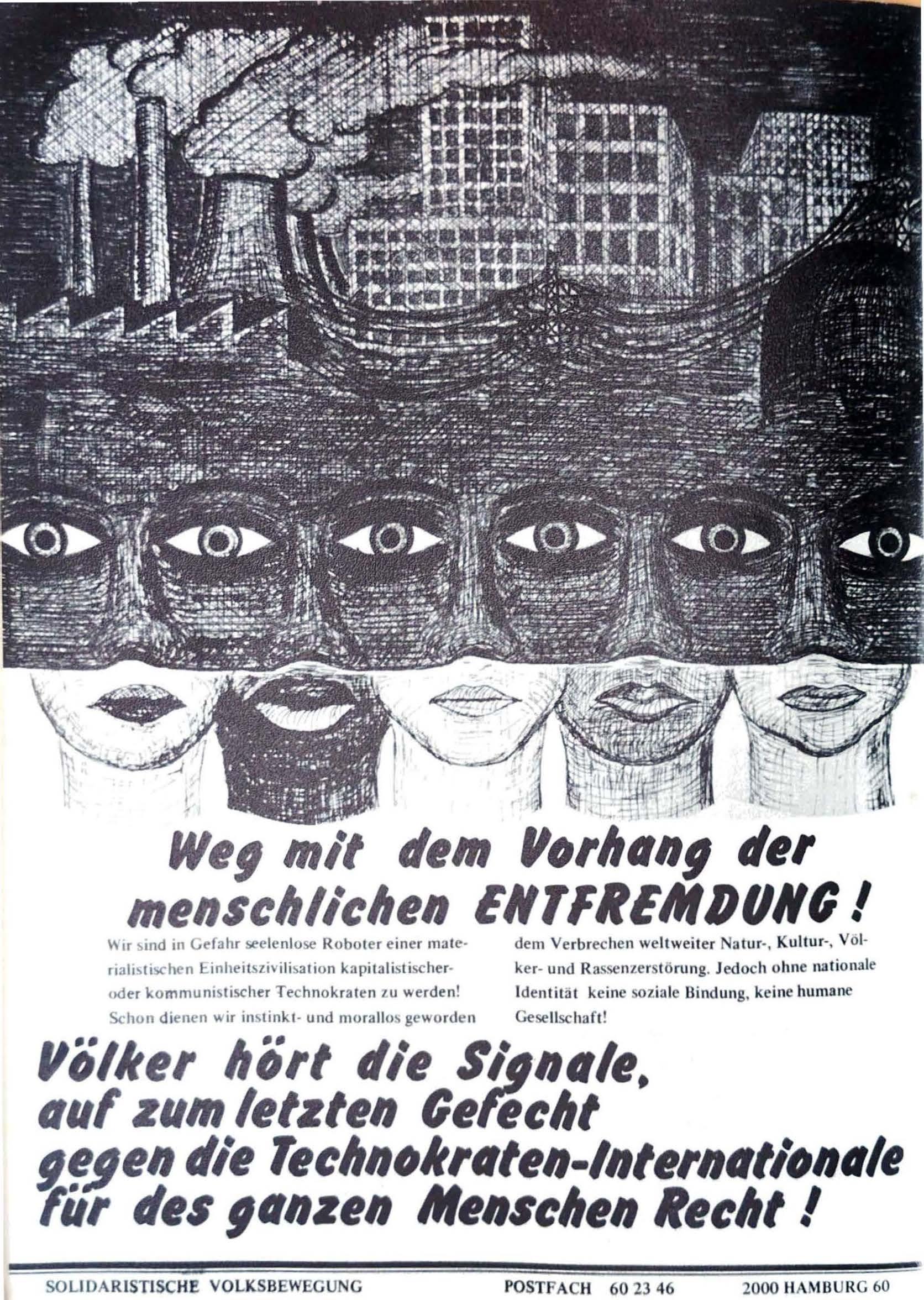
While the drawing adapts the visual elements and universalist claims of the environmental movement, the text reveals the far-right agenda: not only is the environment threatened by capitalist-industrial society, but national identity and “racial purity” are also in danger of disappearing. This shows how the discourses and aesthetics of an environmental movement perceived as left-wing are subtly but unequivocally linked to far-right views.