Utopian Imaginaries in New Left Periodicals - Baldassare Scolari
The subproject investigates how utopian imaginaries of a “good” and non-alienated life were visually and multimodally articulated in West German New Left periodicals during the long 1970s—a period marked by social transformation, crisis, and political reorientation. Drawing on theories of utopia developed by Paul Ricoeur, Fredric Jameson, and Ruth Levitas, the project conceptualizes utopian imaginaries as dialectical critiques of existing conditions that simultaneously project alternative futures.
Unlike classical utopias, which outlined comprehensive social orders with fixed institutions, New Left utopias were open-ended, processual, and rooted in everyday practice. Communes, childcare collectives (Kinderläden), alternative housing and work projects, and experimental forms of political action tested new modes of sociality, subjectivity, and collective organization in the present. While these practices remained connected to anarchist, socialist, and communist traditions—especially critiques of capitalist alienation—they shifted emphasis toward experimentation, flexibility, and performative enactment.
Previous scholarship has primarily approached these developments from intellectual and social history, examining the reception of Marxism and Critical Theory and the practical experiments associated with self-determination, anti-authoritarian education, sexual liberation, and non-hierarchical collective life. The visual and multimodal dimensions, however, have received far less attention. Yet images, layouts, and graphic strategies in New Left periodicals functioned as countercultural interventions. They challenged hegemonic media forms, destabilized dominant models of the “good life,” and articulated alternative moral and social horizons. Analysing these visual utopias thus reveals both the non-alienated worlds envisioned by the New Left and the social orders they sought to transform.
The project compares different strands of the New Left and traces their transformations across the 1970s. In doing so, it engages debates about the “exhaustion of utopian energies” and the emergence of more present-oriented political horizons. While many journals developed distinct visual languages that contested bourgeois norms and foregrounded liberation, they also expressed scepticism toward institutional politics, long-term planning, and teleological models of progress.
Particular attention is paid to how elements of visual culture—symbols, design styles, formats, and aesthetic devices—were appropriated, recombined, and transformed. The analysis examines continuities and ruptures with earlier Left visual traditions as well as differences from perceived hegemonic media. In this way, the project demonstrates how design and imagery became sites for negotiating and reimagining social norms.
Methodologically, the study combines design history, visual studies, semiotics, and multimodal discourse analysis. Through close readings of selected periodicals, it analyzes recurring motifs, representations of bodies, visual figures, and formal languages. Special focus is placed on fragmented layouts, expressive individuality, and open-ended narrative structures. Overall, the project shows how visual culture mediated shifting conceptions of progress at a moment when future-oriented utopias of the labor movement were losing mobilizing force and new experimental forms of political imagination emerged within counter-media contexts.
Source example: Hundert Blumen, 1972, Nr. 5, P. 8-9.
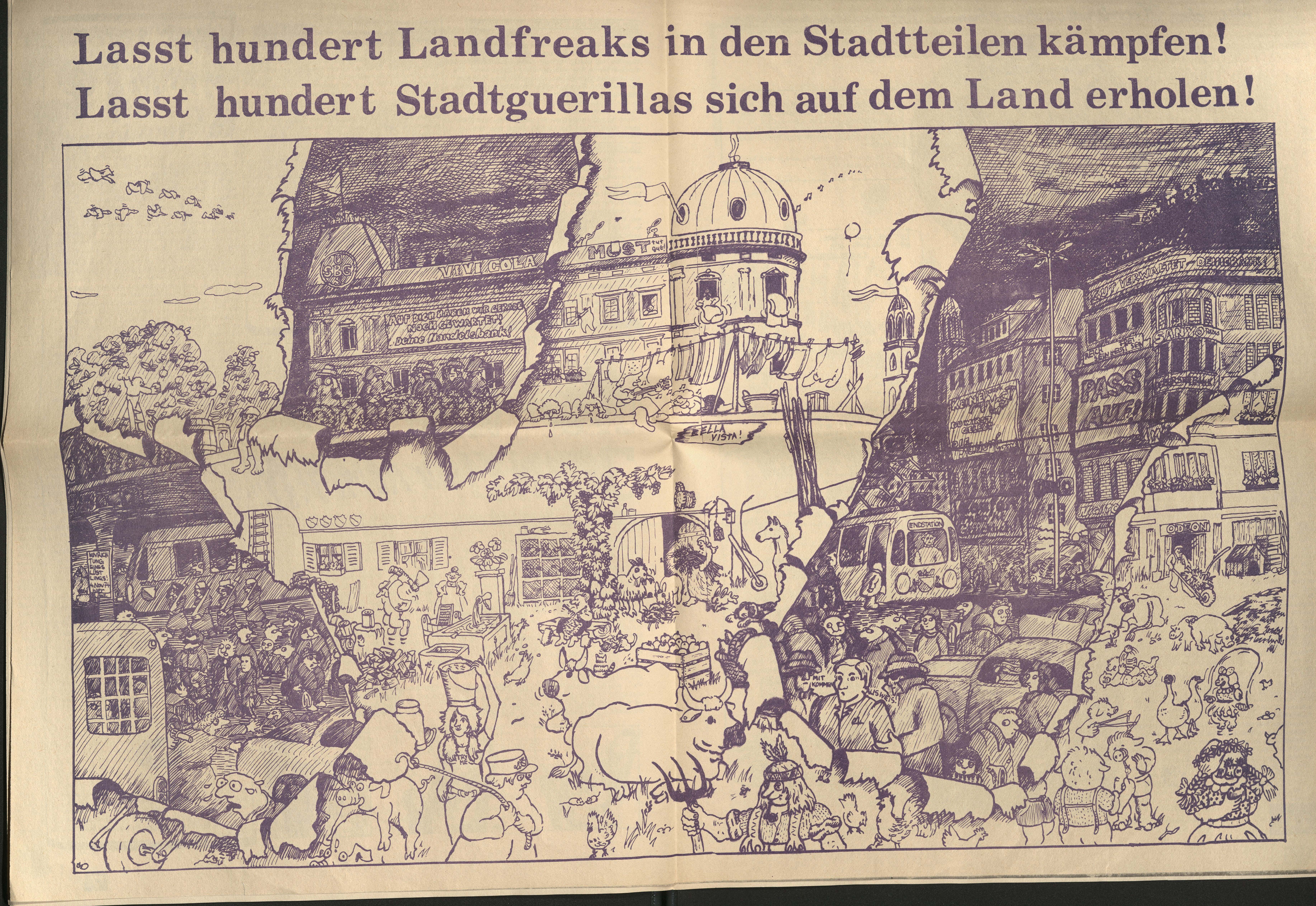
The image exemplarily highlights key elements of the New Left’s utopian imaginary. It articulates a critique of modern urbanity as a dark, disciplining space that regulates and constrains bodies, contrasted with a more joyful environment in which children, women, men, and animals live together, play, work, and engage openly in sexual relations. The image also marks a break with classical utopian representations, where either city or countryside life was idealized in isolation. By contrast, viewers are here invited to imagine “a hundred rural freaks fighting in urban neighborhoods” while “a hundred urban guerrillas recuperate in the countryside.” Within the image itself, an idealized scene blends elements of rural life into the city, suggesting a utopian fusion of urban and rural modes of living.
The depiction of the utopian space as a torn poster, revealing the dissonance of bourgeois-capitalist urban space behind it, suggests that utopia is not a distant, future project but something that can potentially already exist, preceding dystopian reality. Notably, the poster is being ripped by a figure stereotypically representing French authorities or police, likely referencing the events of May 1968 in France. Utopia is thus conceived as realizable in the here and now, without the need for proletarian revolution, because it embodies an “original” space of living disrupted by the agents of the bourgeois-capitalist world.